

What iscritical risk?
Not every risk carries the same weight.
Critical risks are the small number of risks that, if not properly controlled, can result in death or significant permanent disability.
Learn more about how critical risk is definedWhile they’re generally lower in probability, they’re higher in consequence – and they’re the key risks that have the potential to cause the most harm.
The state of those critical risks – whether they’re known, effectively controlled, and verified – is the only predictor of whether someone could be seriously harmed or killed while working in your organisation.
Are you confident you know the current effectiveness of your critical controls?
Common critical risks
If these risks are present in your workplaces, critical risk is already on your radar.
But you may be unsure about how to manage them well.
What this looks like by industry
Construction
Working at height, confined space entry, mobile plant and heavy vehicle interactions, and electrical isolation are usually already identified here. They’re less often verified as an ongoing discipline.
Manufacturing
Fixed plant and machinery, hazardous substances, and confined space entry sit at the centre of most manufacturing risk profiles, often documented in detail but not routinely checked against what’s actually happening on the floor.
Energy, mining and forestry
Mobile plant, electrical hazards, and exposure to hazardous substances or noise are constant, and the consequences of a critical control failing are rarely minor.
Other high-risk environments
Physical aggression and exposure to biohazards show up wherever people work directly with the public or with biological material, including healthcare, retail, and hospitality. Critical risk isn’t only a heavy-industry concept.
Many organisations think they’re managing critical risk. Few are.
Health and safety has a reputation of being overly complex, compliance-heavy, and administratively draining.
Boards and executives are buried in reports, managers duplicate effort, and teams spend time proving health and safety instead of improving it.
Meanwhile:
- Many businesses haven’t identified their critical risks at all.
- Most don’t understand what their critical controls are or what they should be.
- Others have identified their critical risks, but don’t consistently verify that their critical controls are effective – that is, in place and working.
No one sets out to end up here, but we’re left with average practices, false confidence, and exposure that only becomes visible after something goes wrong.
This isn’t just Critter’s read of the landscape. WorkSafe has named managing critical risk a strategic priority, with enforcement attention focused on the high-risk sectors of agriculture, construction, forestry, and manufacturing – exactly where the gap between documented and verified critical controls tends to sit.
The cost of getting it wrong is always higher than the cost of doing it well.

Why critical risk management fails
It’s not controversial to say people should be safe from serious injury, illness, or death at work. And it’s rarely a lack of care that causes critical controls to fail.
Organisations struggle to manage critical risk well because they’re trying to do too much.
By monitoring all controls instead of focusing on critical controls, their view becomes cluttered. They’re overwhelmed by the amount of work they’re doing and the amount of information they’re collecting, and the key insight they need – whether their critical controls are in place and working – gets lost.
Health and safety becomes defensive, over-compliance creeps in, and energy goes into protection from liability instead of protection of people.
And critical risks and controls don’t get the focused attention they need.
This isn’t just good practice advice, either. The Institute of Directors’ governance guide, developed with WorkSafe, tells boards they need to understand their most important critical controls and routinely verify they’re working as intended – not simply trust that documented systems are functioning. That expectation is written into law: section 44 of the Health and Safety at Work Act 2015 requires officers to verify, not just establish, the processes that manage risk.

What good critical risk management looks like
Effective critical risk management is simple, but disciplined:
It doesn’t require hundreds of metrics or endless paperwork – just disciplined attention to the critical few.
Introducing the
Critter Effectiveness Score
We created the Critter Effectiveness Score to answer one confronting but essential question:
Are we comfortable that our critical controls are effective?
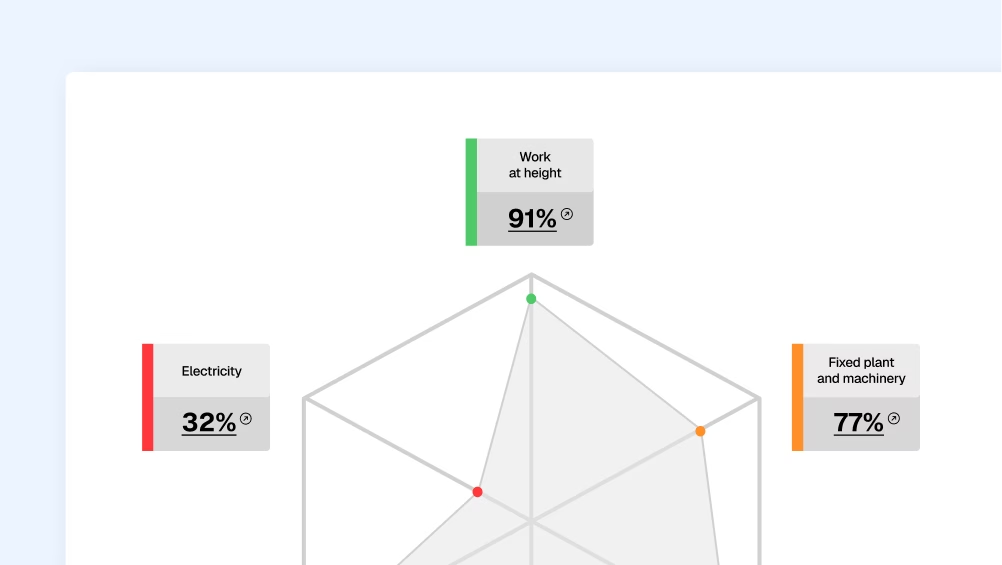
The Critter Effectiveness Score gives leaders clear visibility of whether their critical controls are in place and working.
With this customisable and continuous view, you can see at a glance what’s effectively controlled and what’s not. Drill down by site, activity, risk, or control to understand right away if corrective action is needed.
Critter cuts through compliance clutter and focuses attention where it belongs – on controlling the few risks that can change lives forever.
Investing in critical controls is a smart business decision
Why this matters
While taking the necessary actions now may seem like one more expense on top of many, the only thing more costly than good critical risk management is bad critical risk management.
When leaders treat health and safety as an investment – in productivity, retention, and reputation – the entire organisation benefits.
And importantly, what you need isn’t more health and safety activity – it’s confidence that you’re focusing on the right thing: the effective management of your critical risks.
Critter makes that visible, so leaders can understand early, act decisively, and protect what matters most.
Key takeaways
- Critical risks are the small number of risks that could kill or permanently disable someone – not the whole risk register, and not defined by how often they occur.
- Documenting a critical control isn’t the same as verifying it – a procedure on paper says nothing about whether it’s in place and working today.
- Verification is a legal expectation, not just good practice – officers under HSWA 2015 have a personal duty to verify, not only establish, critical risk systems.
- The industries most exposed – construction, manufacturing, energy, forestry – are also where the gap between documented and verified tends to be widest.